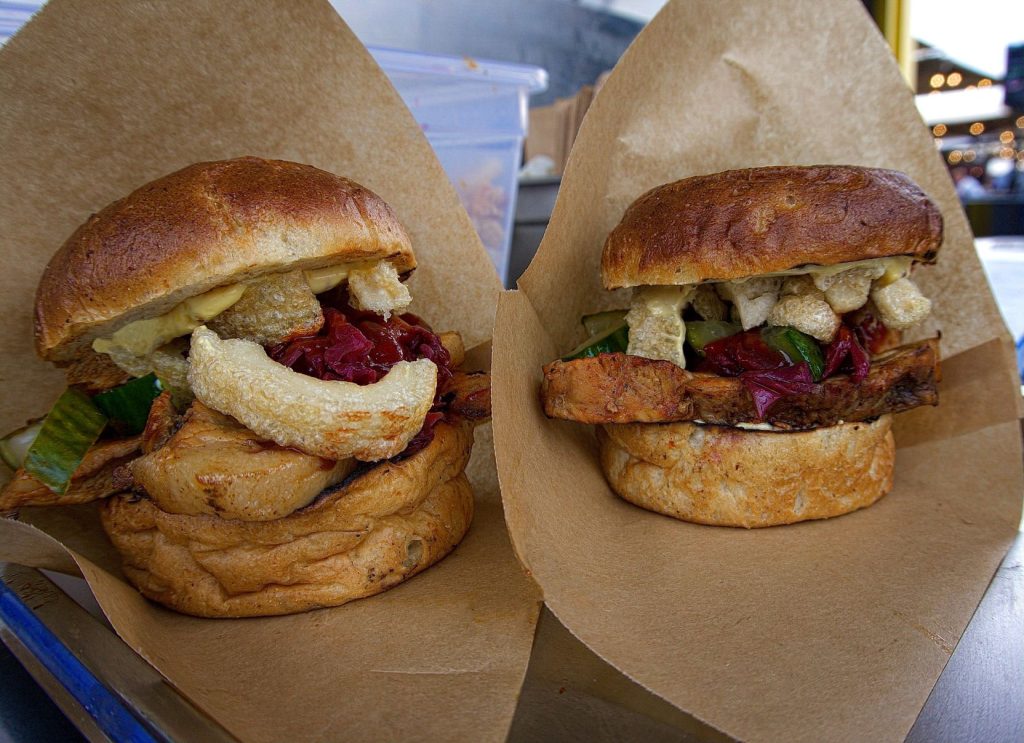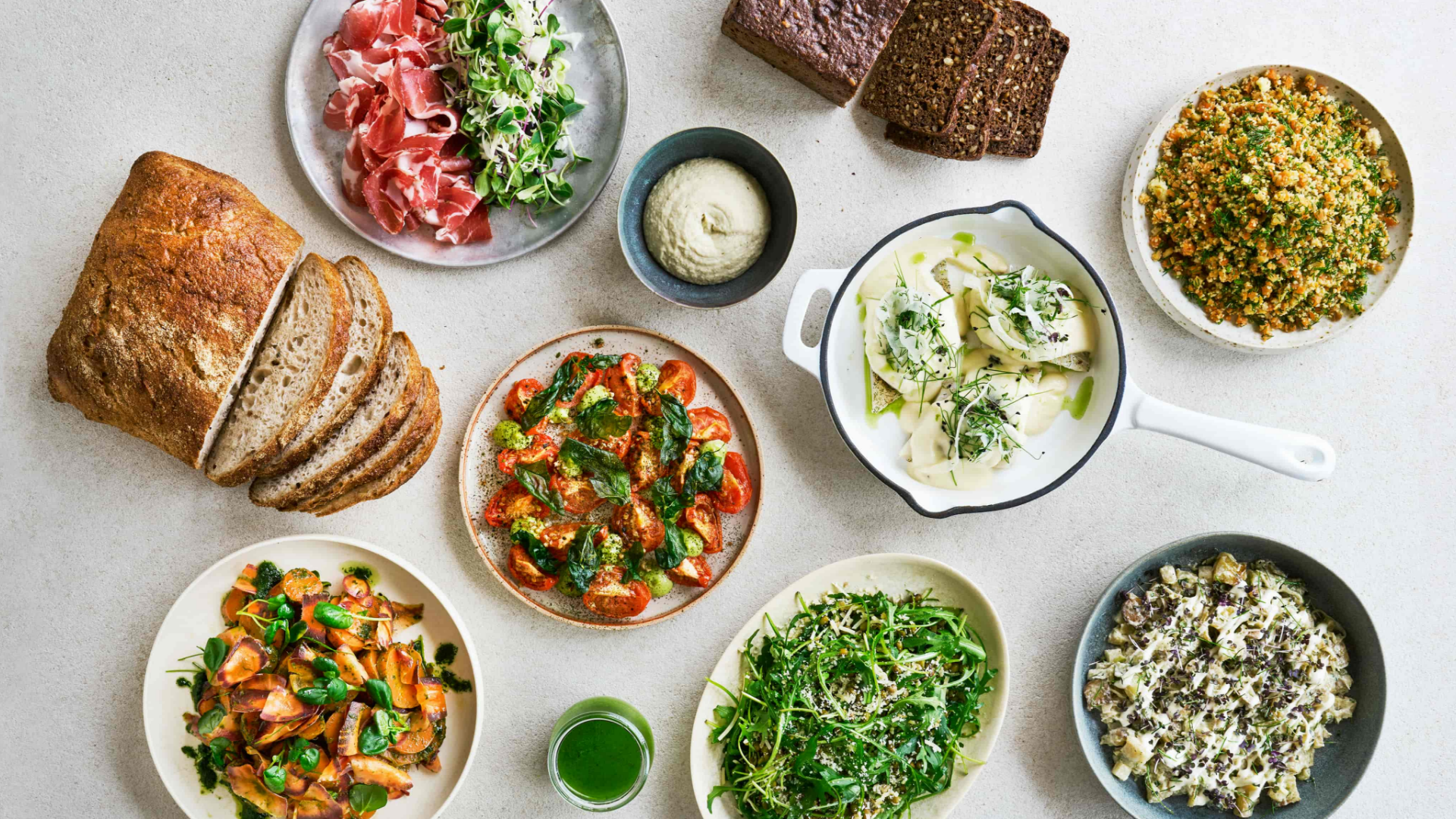
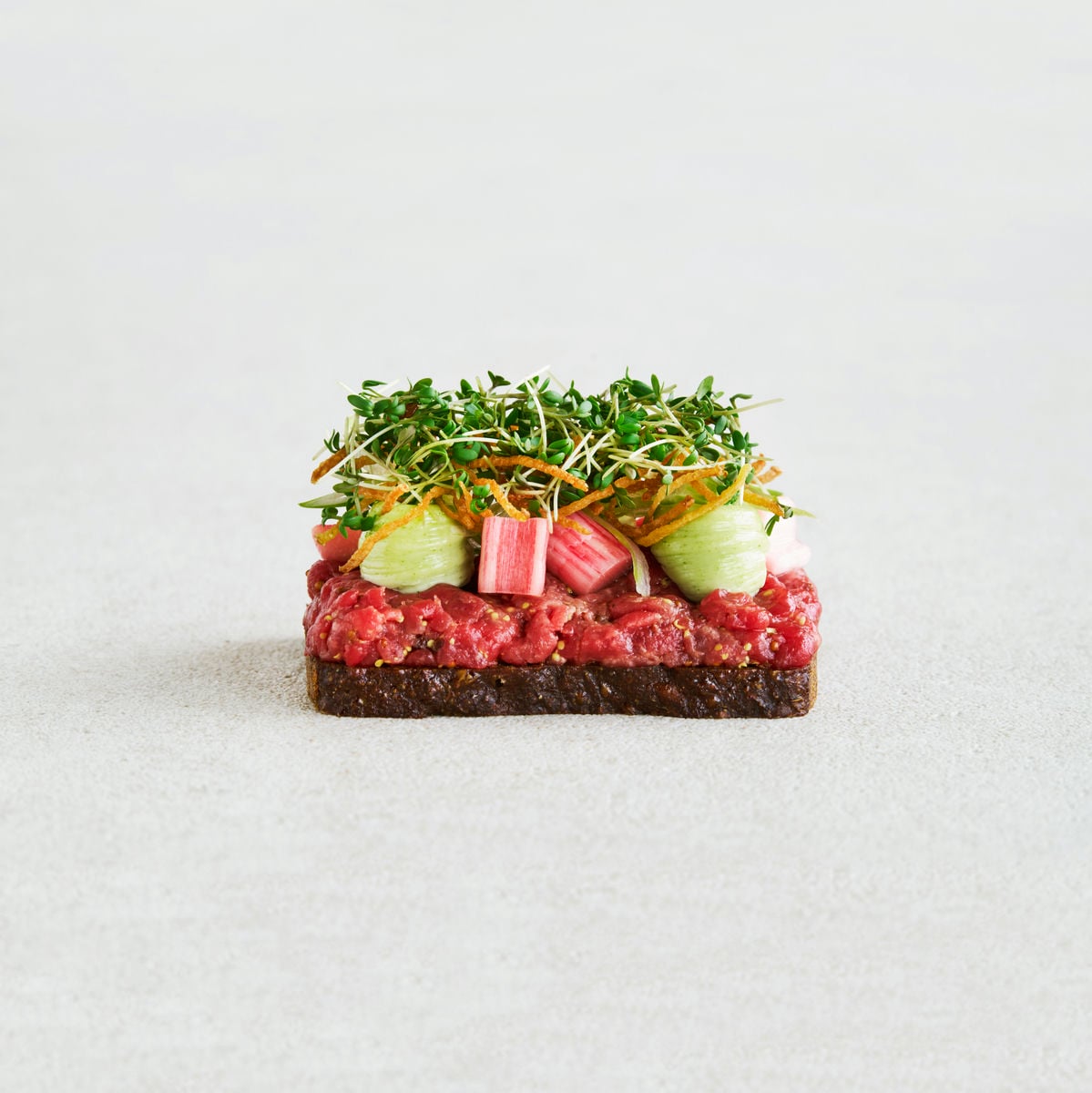
A roast pork sandwich with crispy pork and red cabbage on the side is a real classic. Here is Aamann’s recipe for a delicious roast pork sandwich in soft brioche buns with mustard mayonnaise, pickled celeriac and fermented red cabbage. The ultimate home-cooked dinner. Please note! The red cabbage needs to ferment for about a month before it is ready to use.
Ingredients
See video guides here
Instructions
Start by finding a 2-litre preserving jar for your fermentation. Remove the two outer leaves from the cabbages, rinse the leaves to remove any soil, and set them aside for later use. Cut the cabbages into quarters and remove the inner core from each quarter (you can use the core pieces in another dish). Then slice the cabbage into 1 cm wide strips. Weigh the ingredients and mix everything together in a large bowl. Use your strength and massage the salt into the cabbage mixture with clean hands until it releases its juice. This takes approx. 5 to 10 minutes. Pour the cabbage mixture into the preserving jar along with the extracted juice, which now forms the brine. Press everything down firmly into the jar with your hands so that the cabbage mixture is completely covered by the brine. If you have massaged the cabbage sufficiently, there will be enough brine to cover all the cabbage. Take the outer cabbage leaves and fold them so that they fit the width of the jar. Place them carefully over the cabbage in the preserving jar and press everything down under the brine. Make sure there is 3–4 cm of air at the top of the jar. Seal it and place it to ferment on a plate in a shady spot. Leave the cabbage to ferment for 21 to 28 days, ideally at a temperature of between 18 and 20 degrees. If the temperature is higher than this, the process may be faster; if it is lower, it may be slower.
IMPORTANT: The jar must be opened every day to release the pressure created by the fermentation process – otherwise the jar may burst. This is particularly important during the first 5 to 7 days, when fermentation is at its peak and the cabbage is bubbling with carbon dioxide. Once it is no longer bubbling so intensely, you can open the jar every few days and eventually stop doing so altogether. Taste the cabbage on the 21st day or earlier, depending on the temperature. If it is not sour enough, you can leave it to ferment further. Taste it regularly until the 28th day, by which time it should be ready.
Score the rind of the neck of pork in 1½ cm wide cuts, cutting only down to the fat and not into the meat, as this can cause juices to bubble up and ruin the crispy rind. Rub the meat and the rind thoroughly with salt, working it in between the cracks in the rind as well.
Place the neck of pork, skin-side down, in an ovenproof dish with water coming 1.5 cm up the side of the neck, and place it in the oven at 200 degrees for 15 minutes. Then turn the neck of pork skin-side up and place it on a rack over the ovenproof dish. Turn the oven down to 150 degrees and roast for 1 hour and 15 minutes.
Now turn the oven up to 250 degrees and roast for approx. 10 minutes. Keep a close eye on the pork and crackling during this time. The crackling should bubble up and turn a golden-brown colour. Once it has, remove the pork and leave to rest for 15–20 minutes before carving.
Cut off the top and bottom of the celeriac, then peel the skin from the sides. Rinse the celeriac, knife and chopping board, and cut the celeriac into large slices 2½ cm thick.
Set your mandoline to a thickness of 1 mm and slice the thick slices into thin, long strips using the mandoline. Toss the celery strips with salt in a large bowl and leave to stand for at least 1 hour. Give the celery a stir a couple of times during this time and finally drain it in a sieve. Place the celery in a preserving jar.
Bring the vinegar, sugar and water to the boil with the spices, boil the brine for a couple of minutes and pour it over the celery in the preserving jar. Leave to cool with the lid on and place in the fridge, where it will keep for up to 3 months.
Place the egg yolks in a large bowl along with coarse-grained mustard, a little salt, freshly ground pepper and 1 tbsp vinegar, and whisk well with an electric whisk – or, if you have a good balloon whisk, use that to make the mayonnaise.
Now whisk the oil into the egg yolks a little at a time in a thin stream. Pour slowly enough that the oil is constantly being whisked into the egg yolks. Pause occasionally whilst adding the oil and whisk the mayonnaise thoroughly. Continue until all the oil has been added, then whisk in a little water. Whisk thoroughly again – this helps ensure that the mayonnaise doesn’t separate and that it has a nice, smooth consistency. Finally, season to taste with salt and, if desired, a little extra vinegar. Place the mayonnaise in the fridge immediately, where it will keep for 4–5 days.
Slice the apples thinly and the red onions into rings. Remove some of the pickled celery from the brine and leave them to drain briefly in a sieve. Split the rolls in half and warm them gently in the oven. Slice the roast pork so that each slice has a crispy crackling. Spread the mustard mayonnaise on both halves of the roll and place the pickled celery, red onion and apple slices on the bottom half, followed by a slice of roast pork. Top with the fermented red cabbage and finish with the top half of the roll.